What is D2C, and how is it different from B2C?
D2C (direct-to-consumer) means a brand sells its own products straight to customers, usually through its own website, app or social channels, instead of only through distributors, retailers or marketplaces. B2C is the wider term for any business selling to consumers, including retailers selling other brands' products.
The difference matters for marketing. A D2C brand owns the customer relationship: it sees who bought, can message them again with permission and keeps the margin a retailer would take. It also carries the full cost of finding each customer, which is why D2C marketing is so focused on acquisition cost and repeat purchase.
Many Indian D2C brands also sell on marketplaces. That is still compatible with a D2C strategy, as long as the brand's own store and customer list keep growing too.
What marketing strategy works for D2C brands in India?
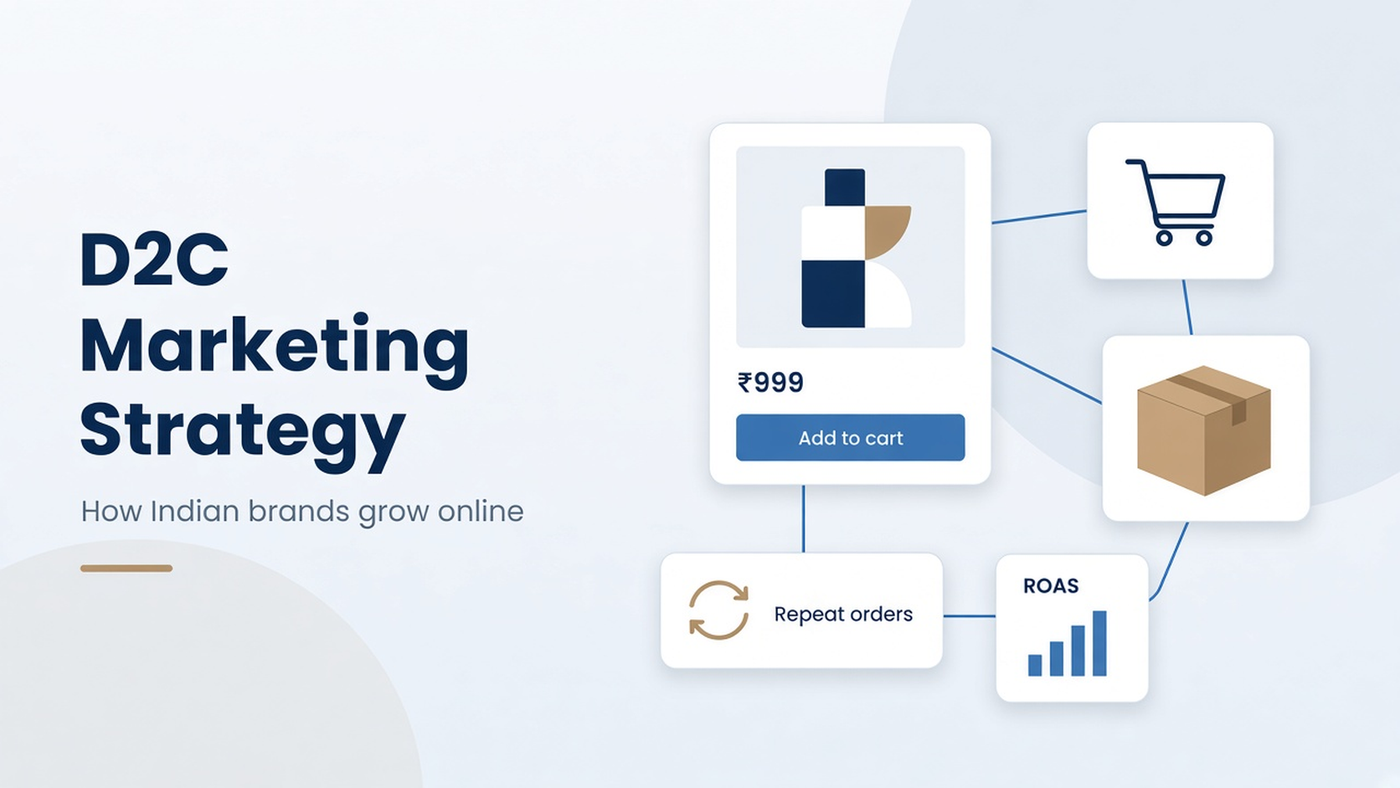
The strategy that works for most D2C brands combines four levers, in this order of priority: conversion, acquisition, retention and search.
- Conversion: a fast store with clear product pages, trust signals and an easy checkout.
- Acquisition: paid social (Meta) and Google Search and Shopping ads with strong creative and proper tracking.
- Retention: repeat orders through email, WhatsApp and remarketing.
- Search: product and category pages that rank, plus free product listings on Google.
Each lever makes the others cheaper. A store that converts better lowers acquisition cost; customers who come back spread that cost over more orders; search brings buyers you do not pay per click for.
[ADD OUR DATA: anonymised growth timeline of one Sharp Rays D2C client, with permission: channels added by month, CAC trend, repeat rate]
How do you make a D2C store convert before scaling ads?
Make the store convert first, because ads only send people; the store has to sell. Check these before adding budget:
- Speed on mobile. Google's Core Web Vitals targets are LCP within 2.5 seconds, INP under 200 milliseconds and CLS under 0.1.
- Product pages that answer questions: clear photos and video, size or usage guidance, ingredients or materials, delivery time and returns.
- Trust signals: real reviews, contact details, a WhatsApp button, clear return and refund policy. [VERIFY: display requirements under India's Consumer Protection (E-Commerce) Rules, 2020 with a legal adviser]
- Simple checkout: guest checkout, the payment methods your buyers use (UPI, cards, COD if you offer it), and no surprise charges at the last step.
- Tracking: purchase, add-to-cart and checkout events firing correctly in Google Analytics, Google Ads and Meta.
Sharp Rays Website Development builds stores on a monthly plan; the Scale plan on the Sharp Rays pricing page (from ₹24,999/month, 6-month minimum for new builds, as listed on 26 Oct 2026) includes a starter online store with catalogue, cart, checkout and payment gateway. Large stores are quoted on request.
How should D2C brands use paid ads and creative?
D2C brands should use Meta ads to create demand with strong creative, and Google Search and Shopping ads to capture people already looking, with purchase tracking in place before spend grows.
- Meta (Facebook and Instagram): short video, creator-style content and clear offers. Test creative more often than audiences. Our guide to creator marketing for brands covers how to choose creators who fit.
- Google Search and Shopping: for brand searches, product searches and category searches. For stores, these campaigns draw on your Merchant Center product feed, so keep titles, prices and stock accurate. [VERIFY: current Shopping/Performance Max feed requirements]
- Tracking: Meta's Conversions API page says server events are less affected than the pixel by browser loading errors, connectivity issues and ad blockers, and recommends using it alongside the pixel.
- Bidding to value: Google's target ROAS bidding aims for an average return on ad spend equal to your target, using the conversion values you report, so send accurate order values.
Sharp Rays Performance Marketing manages Google and Meta campaigns for ecommerce brands, with ads management from ₹9,999/month on the pricing page (ad budget paid directly to the platform). See also the Sharp Rays ecommerce marketing page.
Want to know what is holding your store back? Sharp Rays will review your store, tracking and ads and send 3-5 priority opportunities. Request a free store audit.
How do D2C brands get repeat orders with email and WhatsApp?
D2C brands get repeat orders by staying in touch after the first purchase with useful, timely messages, sent only to people who agreed to receive them. Common retention flows:
- Order and delivery updates that set expectations and reduce "where is my order" calls.
- How-to-use and care messages a few days after delivery.
- Replenishment reminders for products that run out (skincare, food, supplements).
- Review requests once the customer has used the product.
- Win-back messages for customers who have not ordered in a while.
Two rules apply. The WhatsApp Business Messaging Policy says you may contact people only if they gave you their number and opted in to receive messages from you. For email, Google's sender guidelines require marketing messages to Gmail users to support one-click unsubscribe and show a visible unsubscribe link. Our guide to WhatsApp marketing for businesses covers WhatsApp in more depth.
Should D2C brands invest in SEO, Google Shopping and marketplaces?
Yes, once the store converts: search and free product listings bring buyers you do not pay per click for, and marketplaces add reach. Start with:
- Free product listings on Google. Google Merchant Center's free listings page says eligible products can appear at no cost on Google Search, Maps, Gemini, YouTube, the Shopping tab, Images and Lens. In India, shipping settings or shipping costs are required.
- Category and product page SEO. Google's ecommerce best practices cover sharing product data, structured data, URL structure and product reviews. [LINK: ecommerce SEO tips, /blog/ecommerce-seo-tips, planned]
- Marketplaces for reach, while keeping your own store as the place for repeat buyers and full-price sales. [VERIFY: marketplace fee and policy details before naming any platform]
Which metrics should a D2C brand track: CAC, ROAS or repeat rate?
Track all three together, because each one alone can mislead. A brand can show high ROAS on returning customers while paying too much for new ones.
- Customer acquisition cost (CAC) = marketing spend ÷ new customers.
- Return on ad spend (ROAS) = revenue from ads ÷ ad spend.
- Repeat purchase rate = customers who ordered more than once ÷ all customers in a period.
- Average order value (AOV) = revenue ÷ orders.
- Contribution margin per order, after product cost, shipping, payment fees, returns and ad cost. This shows whether growth is profitable.
- Conversion rate = orders ÷ store sessions.
Set targets from your own margins, not from industry averages you cannot verify. [ADD OUR DATA: CAC, ROAS and repeat rate trend for one anonymised Sharp Rays D2C client]
What are some D2C marketing examples?
D2C marketing looks different by category, but the strongest examples combine one hero product, a clear story and a reason to come back. Examples by type of brand:
- A skincare brand runs creator videos on Meta, sends routine and refill reminders on WhatsApp, and builds ingredient guides for search.
- A food or beverage brand uses Shopping ads for product searches, subscription or bundle offers, and recipe content.
- A fashion brand tests new collections with Meta creative, uses Google free listings for product discovery, and sends size and restock alerts by email.
- A home or electronics brand invests in detailed product pages, comparison guides and review requests, because buyers research longer.
[ADD OUR EXAMPLE: one real Sharp Rays D2C campaign, with client permission: category, levers used, what changed]. If you are still at the launch stage, see [LINK: how to start a D2C brand in India, /blog/how-to-start-a-d2c-brand-india, planned].
"[ADD OUR QUOTE: one line from a named Sharp Rays ecommerce specialist on the first fix most D2C stores need]" - [NAME, ROLE]
FAQs
Is D2C only for big brands with funding?
No. Small brands can start D2C with a simple store, one hero product and one ad channel. What matters is knowing your margins, so you know how much you can spend to win a customer.
Should a new D2C brand sell on marketplaces too?
Often, yes, for reach and trust. Keep your own store and customer list growing alongside, because marketplace customers usually belong to the marketplace, not to you. [VERIFY: marketplace data-sharing terms]
Do D2C brands need an app?
Not at the start. A fast mobile website handles most early D2C sales. Consider an app only when repeat customers are a large share of orders and you have a reason they would open it. [ADD OUR DATA: share of mobile orders on Sharp Rays-built stores]
How much should a D2C brand spend on ads?
There is no fixed figure. Work backwards from your margin per order and the CAC you can afford, start with a test budget, and scale only what stays within that limit. Ad budget is separate from any agency fee.
Is cash on delivery a good idea for D2C in India?
It can lift conversion for first-time buyers but may increase returns and failed deliveries. Test it, track return-to-origin rates and decide by product. [ADD SOURCE: any official data on COD share or RTO rates]
Want more sales from your online store? Sharp Rays will review your store, tracking and ads and send 3-5 priority opportunities, at no cost.