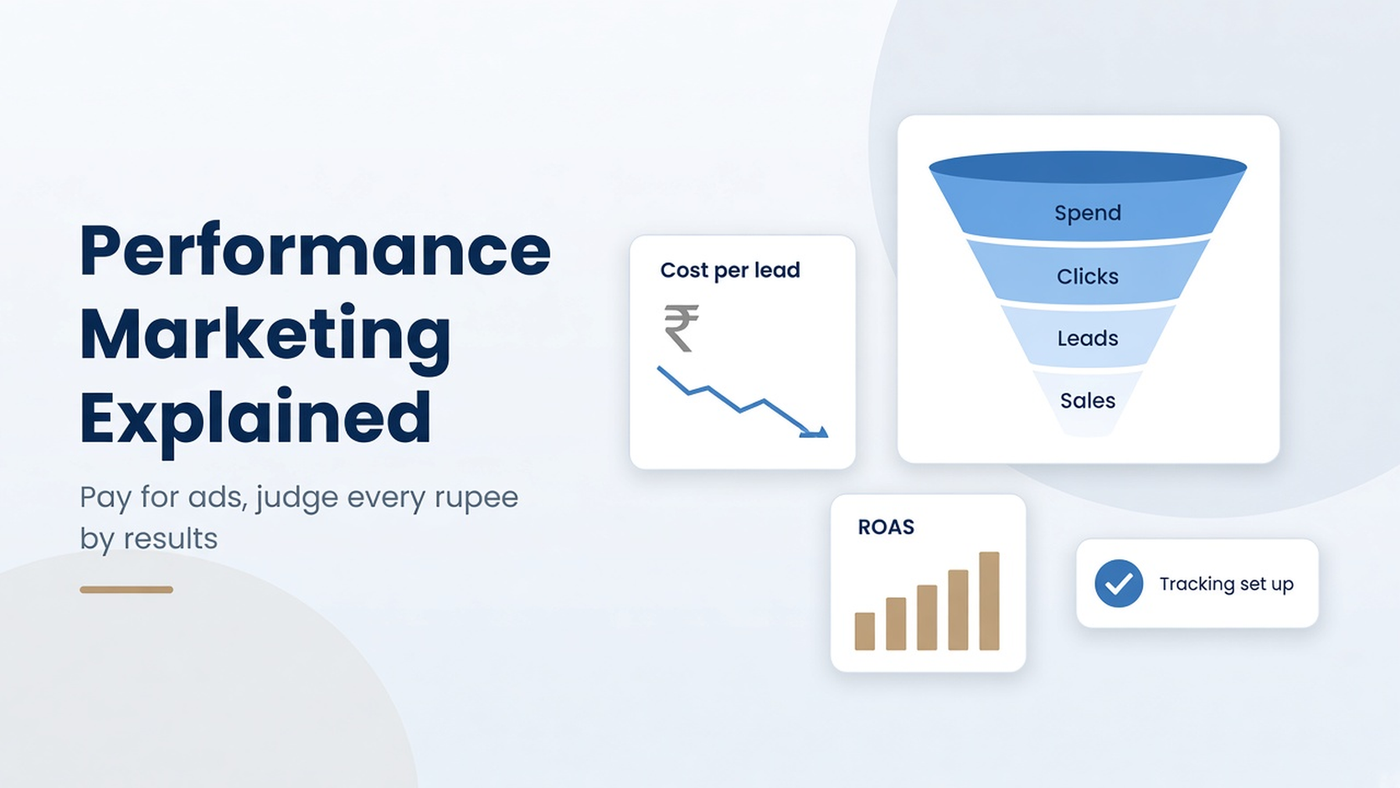
What is performance marketing in simple words?
Performance marketing is advertising you pay for and judge only by results you can count. Instead of asking "how many people saw the ad?", a performance marketer asks "how many enquiries, calls or sales did each rupee bring, and at what cost?"
In practice, a small business usually runs performance marketing on Google Ads and Meta (Facebook and Instagram) ads. You set a budget, the platform charges for clicks or impressions, and you measure what those clicks turned into. Google Ads describes conversions the same way: you choose what is valuable to your business, like a purchase, a sign-up or a phone call, and Google Ads helps you get the most of those actions.
How does performance marketing work?
Performance marketing works as a loop: decide the result you want, track it, spend a controlled budget, read the numbers and change what is not working. The usual order is:
- Pick one result to pay for. For a clinic it might be appointment calls; for a D2C brand, online purchases; for a B2B firm, qualified form leads.
- Set up tracking so every result is recorded against the ad, keyword or audience that brought it.
- Choose the channel where your buyers already search or scroll (see below).
- Launch with a test budget and a small number of ads and audiences.
- Let the platform learn, then cut what costs too much per result and move budget to what works.
- Check lead quality with sales, not just the ad dashboard, and repeat.
What is the difference between performance marketing and digital marketing?
Digital marketing is the whole umbrella of online marketing; performance marketing is the part of it where you pay for ads and measure them by results. SEO, social media posting, content and email are also digital marketing, but you do not pay per click for them and their results build more slowly.
- How you pay - Performance marketing: Platform charges for clicks, impressions or results, plus any management fee; Wider digital marketing (SEO, content, organic social): Time and fees for work done; no payment per click
- Speed - Performance marketing: Ads can run as soon as they are approved; Wider digital marketing (SEO, content, organic social): Results build over months
- Main measure - Performance marketing: Cost per lead, cost per sale, return on ad spend; Wider digital marketing (SEO, content, organic social): Rankings, organic traffic, engagement, enquiries
- When spend stops - Performance marketing: Ad traffic stops; Wider digital marketing (SEO, content, organic social): Pages and posts can keep bringing visits
Most small businesses need both. Google is clear that ads and organic search are separate: its page Do you need an SEO? says advertising with Google won't have any effect on your site's presence in its search results. For the organic side, see Sharp Rays Search Engine Optimization.
Which channels are used for performance marketing?
For most small and medium businesses in India, performance marketing means Google Ads and Meta ads, chosen by where buyers are in their decision:
- Google Search ads reach people who are already searching for what you sell, such as "physiotherapist near me" or "CA for GST filing".
- Meta ads (Facebook and Instagram) reach people by interest, location and behaviour before they search, which suits visual products, offers and local services.
- YouTube and Google Display add video and banner reach, usually after search is working.
- Shopping and Performance Max campaigns suit online stores with a product feed.
- Marketplace and other ad platforms can fit specific sectors. [VERIFY: name only platforms Sharp Rays actually manages]
Start with one channel, prove the numbers, then add the next. Our guide to Google Ads in the AI era explains how Google's automated campaign types change what business owners control.
Why must tracking come before spending?
Tracking comes first because without it you cannot tell which rupee brought which lead, and the ad platforms cannot learn who to show your ads to. Google lists the benefits on its conversion measurement page: you learn which keywords, ads and campaigns drive valuable actions, understand your return on investment, and can use Smart Bidding strategies such as Maximize Conversions, target CPA and target ROAS.
Before the first ad goes live, set up:
- Google Ads conversion tracking for form submissions, calls and WhatsApp clicks (or purchases for stores).
- Google Analytics key events, which Google Ads can import. Google's help page on key events explains how to mark them.
- The Meta Pixel on your website. Meta describes the Meta Pixel as a piece of code that measures the actions people take on your site after seeing your ads.
- Meta Conversions API, which Meta says is less affected than the pixel by browser loading errors, connectivity issues and ad blockers (About Conversions API).
- A simple lead sheet or CRM that records where each lead came from and whether it became a sale.
Meta also warns that you must not send prohibited information, such as health or financial data, through the pixel. Clinics, finance and education businesses should check their set-up carefully. For a step-by-step set-up, see [LINK: Google Ads conversion tracking set-up, /blog/google-ads-conversion-tracking-setup, planned].
Not sure your ads are tracking the right results? Sharp Rays will review your Google Ads or Meta ads set-up and tracking and send you 3-5 priority opportunities to fix. Request a free ads audit.
How much budget do you need, and how do you test?
There is no single right budget; it must be big enough for the platform to collect results and small enough that you can afford to test. Two official rules help you plan:
- Google Ads daily budgets: Google's page on choosing your bid and budget says spend on a single day can go up to 2 times your average daily budget, but over a billing period you will not be charged more than 30.4 times your average daily budget.
- Learning phases: Google's conversion page says Smart Bidding needs a standard 7-14 day learning phase, and frequent changes to budgets, targets or goals reset it. Meta's learning phase page says an ad set usually exits learning after about 50 results in the week after its last significant edit.
A sensible way to test:
- Fix a test period and budget in advance and do not change settings daily.
- Test one thing at a time: audience, ad message or landing page.
- Keep the number of campaigns and ad sets small so each gets enough data. Meta recommends avoiding high ad volumes for this reason.
- Decide your stop rule before you start, for example the highest cost per lead you can afford.
Ad budget is separate from management fees. Sharp Rays' pricing page lists Google and Meta ads management from ₹9,999/month (1 platform), ₹16,999/month (up to 2 platforms) and ₹23,999/month (up to 3 platforms), and states that the ad budget is paid directly to the platform. For typical click costs, see [LINK: Google Ads cost in India, /blog/google-ads-cost-india, planned].
Which metrics matter in performance marketing: CPL, CPA or ROAS?
The metrics that matter are the ones tied to money: cost per lead, cost per acquisition and return on ad spend. Clicks and impressions only explain why those numbers moved.
- Cost per lead (CPL) = ad spend ÷ number of leads. Best for service businesses.
- Cost per acquisition (CPA) = ad spend ÷ number of customers or sales. Google's target CPA bidding uses this idea.
- Return on ad spend (ROAS) = revenue from ads ÷ ad spend. Google's target ROAS bidding aims for an average return on ad spend equal to the target you set, using the conversion values you report.
- Lead-to-sale rate = sales ÷ leads. This shows lead quality, which the ad platforms cannot see unless you send it back.
- Click-through rate and cost per click help diagnose problems but are not goals on their own.
[ADD OUR DATA: anonymised funnel from one Sharp Rays account, with permission: monthly spend, clicks, leads, sales, CPL and what we changed]
If your leads are cheap but never buy, the problem is quality, not cost. Our guide to Meta ads lead quality covers how to attract buyers instead of irrelevant enquiries.
What are some examples of performance marketing?
Performance marketing looks different for each type of business, but each example pays for ads and measures one clear result:
- A local clinic runs Google Search ads for treatment searches in its area and measures booked appointments from calls and WhatsApp chats.
- A D2C brand runs Meta ads and Shopping campaigns and measures purchases and ROAS from its online store.
- A coaching institute runs Meta lead ads for a new batch and measures counselling calls that turn into admissions.
- A B2B manufacturer runs Google Search ads for product and industrial terms and measures qualified quote requests.
[ADD OUR EXAMPLE: one real Sharp Rays performance campaign, with client permission: business type, channel, result tracked and what changed after the first month]
When is performance marketing not the right fit?
Performance marketing is not the right fit when you cannot track results, cannot handle the leads or cannot afford a fair test. Hold off on ads if:
- Your website or landing page is slow, unclear or has no working call, WhatsApp or form button.
- No one can answer enquiries quickly; paid leads go cold fast.
- You cannot afford to run a test long enough to get past the learning phase.
- Your offer or price is not yet clear, or the product is not ready to sell.
- You expect guaranteed results. Sharp Rays' pricing page states plainly that no one controls Google or Meta and that Sharp Rays does not promise guaranteed leads or a fixed ROI.
In these cases, fix the website and tracking first. Sharp Rays Performance Marketing starts with tracking and a conversion review before scaling spend.
"[ADD OUR QUOTE: one line from a named Sharp Rays ads specialist on the first thing we check before spending a client's budget]" - [NAME, ROLE]
FAQs
Is performance marketing the same as affiliate marketing?
No. Affiliate marketing pays partners a commission for sales they refer. Performance marketing, in the sense used by most small businesses, means running your own paid ads on platforms like Google and Meta and measuring them by results. Both are judged on outcomes, which is why the terms are sometimes mixed up.
Can I run performance marketing without a website?
Partly. Meta lead forms, call ads and click-to-WhatsApp ads can collect enquiries without a website. But a fast landing page usually gives more control over tracking and the message. Check each ad format's requirements in the platform before you launch. [VERIFY: current Google Ads call-only/lead form asset requirements]
How soon can performance marketing bring leads?
Ads can start bringing clicks once they are approved, but stable results take longer. Google says Smart Bidding needs a 7-14 day learning phase, and Meta ad sets usually leave learning after about 50 results in a week. [ADD OUR DATA: typical time to first stable CPL on Sharp Rays accounts]
Does a performance marketing agency get paid only for results?
Not usually. Most agencies, including Sharp Rays, charge a monthly management fee, and the ad budget is paid directly to Google or Meta. Ask any agency what its fee covers and how it reports results from your real ad accounts.
Who should own the ad accounts?
You should. Keep Google Ads, Meta Business and analytics accounts in your business's name and give the agency access. The Sharp Rays pricing page states that clients' ad accounts, content and data stay in their name.
Want to know if your ad spend is tracked properly? Sharp Rays will review your ads and tracking set-up and send 3-5 priority opportunities to fix, at no cost.